
Frontline Employee Training: Best Practices, Common Challenges, and How to Scale Learning
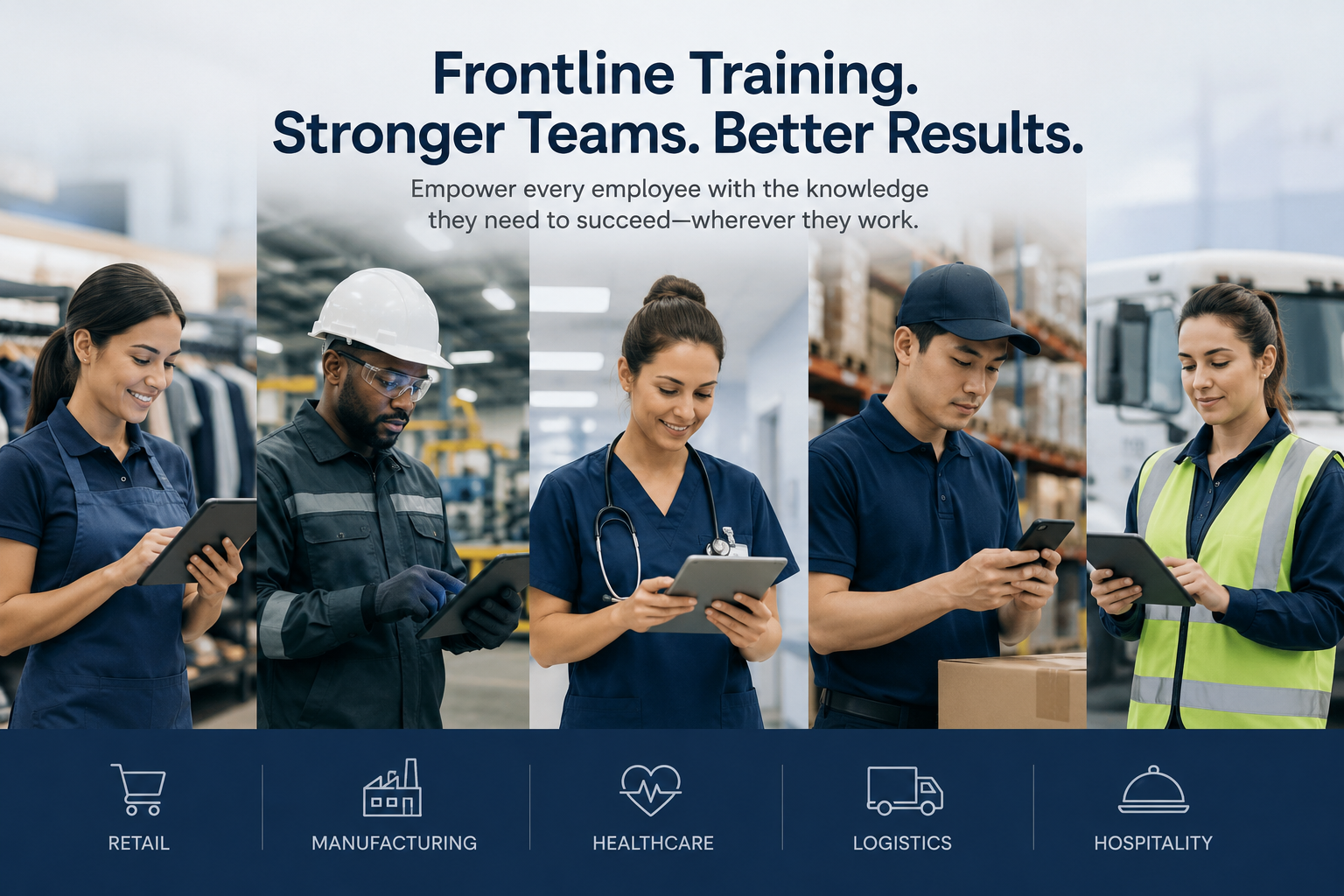
Every interaction a frontline employee has with a customer, patient, guest, or colleague has the potential to shape business outcomes.
A retail associate helps a customer choose the right product. A technician follows a critical safety procedure. A nurse completes mandatory compliance tasks before starting a shift. A warehouse employee learns how to operate new equipment safely.
When frontline employees are well trained, they make better decisions, deliver more consistent customer experiences, and contribute to safer, more efficient operations.
Yet many organizations still struggle to make frontline employee training effective.
Employees complete mandatory courses but quickly forget what they learned. Managers spend valuable time coordinating training across multiple locations. New hires take longer than expected to become productive, while compliance requirements continue to grow.
The result?
Training becomes an administrative task instead of a strategic business advantage.
For organizations with large frontline workforces, whether in manufacturing, retail, healthcare, logistics, hospitality, or the public sector, the challenge is not creating more learning content.
The challenge is delivering learning that is accessible, engaging, and scalable while ensuring employees retain knowledge and confidently apply it on the job.
Organizations that solve this challenge improve onboarding, strengthen compliance, increase operational consistency, and create better customer experiences.
In this guide, you'll learn the biggest challenges organizations face when training frontline employees, the best practices leading organizations use to improve learning outcomes, and how modern learning platforms like CT Nova help deliver personalized learning experiences at scale.
Table of Contents
Why Frontline Training Is Different
Training frontline employees is fundamentally different from training office-based teams.
Unlike desk-based employees, frontline workers spend most of their day serving customers, operating equipment, travelling between locations, caring for patients, or managing essential operations. Learning has to fit naturally into the workday instead of interrupting it.
This creates challenges that traditional training methods were never designed to solve.
Many frontline employees rely on mobile devices instead of desktop computers. They often work different shifts, have limited uninterrupted time for learning, and need quick access to information while performing their jobs.
At the same time, learning and development teams must deliver a consistent learning experience across multiple locations, departments, and roles while meeting compliance requirements and reducing administrative effort.
Traditional approaches, such as lengthy e-learning modules, annual refresher courses, and static presentations, may satisfy reporting requirements. However, they rarely improve long-term knowledge retention or day-to-day performance.
Leading organizations are taking a different approach.
Instead of treating learning as a one-time event, they create continuous learning experiences that are shorter, more personalized, and easier to access.
The goal is not simply to help employees complete training.
It is to help them perform better in their roles.
Key Takeaway
The best frontline training programs are designed around how employees actually work. They make learning accessible, continuous, and relevant to everyday tasks.
The Biggest Challenges in Frontline Employee Training
Training frontline employees has never been more important.
At the same time, it has never been more complex.
Organizations today manage larger, more distributed workforces while navigating evolving compliance requirements, changing customer expectations, and ongoing skills gaps.
Learning teams are expected to deliver consistent training experiences across every location without increasing administrative effort.
The biggest challenge is not creating training content.
It is ensuring employees can access, retain, and apply what they learn in real-world situations.
Here are the five biggest challenges organizations face.
1. Low Knowledge Retention
Completing a course does not necessarily mean employees have learned the material.
Many organizations rely on one-time onboarding sessions or annual compliance training. Employees complete a course, pass an assessment, and move on. Without regular reinforcement, much of that information is forgotten before it is needed on the job.
This creates a gap between training completion and workplace performance.
Leading organizations address this by making learning continuous. Instead of relying on a single training event, they reinforce key concepts through short learning modules, knowledge checks, and ongoing practice.
Key Takeaway
Learning should not end when a course is completed. Continuous reinforcement helps employees retain knowledge and apply it with confidence.
2. High Workforce Turnover
Industries such as retail, healthcare, hospitality, logistics, and manufacturing often experience frequent employee turnover.
Every new hire requires onboarding, role-specific training, safety education, and compliance training.
As organizations grow, managing these processes manually becomes increasingly difficult.
When onboarding is inconsistent, new employees take longer to become productive. Managers spend more time coordinating training, and learning teams struggle to deliver a consistent experience across locations.
Modern learning platforms reduce this burden by automating learner enrolment, organizing learning paths, and giving administrators greater visibility into employee progress.
3. Inconsistent Learning Experiences
Employees performing the same role should receive the same standard of training.
In reality, training often varies depending on location, manager involvement, or local processes.
One employee may receive structured onboarding with clear learning objectives, while another receives only basic instructions.
These inconsistencies can lead to:
Uneven customer experiences
Operational inefficiencies
Increased compliance risk
Longer time to proficiency
Standardizing training while allowing flexibility for role-specific learning helps organizations deliver a more consistent learning experience across every location.
4. Limited Time for Learning
Frontline employees spend their day serving customers, operating equipment, travelling between sites, or managing essential operations.
Unlike office-based employees, they rarely have uninterrupted hours available for training.
Learning needs to fit naturally into the workday.
Long courses often lead to lower completion rates and reduced engagement because employees simply do not have the time to complete them in one sitting.
Short, focused learning experiences are easier to complete, easier to revisit, and easier to remember.
Organizations that design learning around the realities of frontline work often see higher learner engagement and better knowledge retention.
5. Measuring Completion Instead of Learning
Many organizations can tell you who completed a course.
Far fewer can tell you whether employees actually understood the material or improved their performance.
Completion rates are useful, but they only provide part of the picture.
Organizations should also measure:
Knowledge retention
Assessment performance
Time to proficiency
Skill progression
Learner engagement
Compliance readiness
These insights help learning teams identify knowledge gaps, improve future training programs, and demonstrate the business impact of learning initiatives.
Platforms like CT Nova support this by providing centralized reporting and learner progress tracking, giving organizations greater visibility into training performance.
| Traditional Frontline Training | Modern Frontline Learning |
|---|---|
| ✕ One-time onboarding | ✓ Continuous learning |
| ✕ Long training sessions | ✓ Microlearning |
| ✕ Manual administration | ✓ Automated learning workflows |
| ✕ Desktop-first learning | ✓ Mobile-friendly learning |
| ✕ Generic learning paths | ✓ Personalized learning experiences |
| ✕ Completion tracking | ✓ Learning analytics and actionable insights |
Best Practices That Improve Frontline Employee Training
Organizations that consistently deliver effective frontline training do more than create high-quality learning content.
They build learning experiences that are accessible, relevant, and designed around the realities of frontline work. At the same time, they give learning teams the tools to manage training efficiently and continuously improve outcomes.
Here are five best practices that help organizations build more effective frontline employee training programs.
1. Design for Microlearning
Frontline employees rarely have uninterrupted hours available for training.
Breaking learning into short, focused modules allows employees to complete training between shifts, during natural breaks, or whenever they have a few minutes available.
Microlearning also improves knowledge retention because employees focus on one concept at a time instead of trying to absorb large amounts of information in a single session.
For organizations, this often leads to higher completion rates, stronger learner engagement, and better long-term retention.
Key Takeaway
Short learning experiences are easier to complete, easier to retain, and easier to revisit when employees need a refresher.
2. Reinforce Learning Continuously
Learning should not stop when a course is completed.
Without reinforcement, employees naturally forget information over time. Regular knowledge checks, refresher modules, quizzes, and practical exercises help employees retain knowledge and apply it more confidently in their daily work.
Continuous learning also makes it easier to introduce new procedures, policy updates, and compliance requirements without requiring employees to complete lengthy retraining programs.
Organizations that reinforce learning regularly build a workforce that is better prepared to adapt to change.
3. Personalize the Learning Experience
Every employee has different learning needs.
A new hire, an experienced technician, and a frontline supervisor require different training based on their responsibilities, experience, and career stage.
Personalized learning helps employees focus on the content that is most relevant to their role instead of searching through large course catalogs.
Modern learning platforms like CT Nova support this by surfacing relevant courses, organizing learning based on progress, and providing personalized dashboards that clearly show learners what they should complete next.
When employees know exactly where to start and what comes next, they are more likely to stay engaged throughout their learning journey.
4. Remove Friction From the Learning Experience
Even great training content can fail if the learning experience is difficult.
Employees are less likely to engage with learning if they struggle to find the right course, lose their progress after switching devices, or spend more time navigating the platform than actually learning.
An effective learning experience should make it easy for employees to:
Search for relevant training
Resume learning across devices
Track their learning progress
Understand what they need to complete next
Removing these barriers reduces frustration and encourages employees to engage with learning more consistently.
5. Measure Learning, Not Just Completion
Completion rates tell you whether employees finished a course.
They do not tell you whether training improved performance.
Organizations should also monitor:
Knowledge retention
Assessment performance
Learner engagement
Time to proficiency
Skill progression
Compliance readiness
These insights help learning teams identify knowledge gaps, improve future training programs, and demonstrate the business impact of learning initiatives.
CT Nova supports this through centralized reporting and learner progress tracking, giving administrators greater visibility into training performance across teams, departments, and locations.
Key Takeaway
The most effective training programs are measured by employee performance and business outcomes, not simply course completion.
How to Scale Frontline Employee Training
As organizations grow, delivering consistent frontline employee training becomes increasingly challenging.
Processes that work for a workforce of 100 employees rarely work for 10,000. Coordinating onboarding, compliance training, role-specific learning, and ongoing development across multiple locations requires more than manual processes.
Scaling frontline employee training is not about creating more courses.
It is about creating learning experiences that are consistent, engaging, and easy to manage across the organization.
Successful organizations achieve this by combining proven learning strategies with technology that simplifies administration, personalizes learning, and provides greater visibility into learner progress.
An effective frontline learning strategy typically includes:
Standardized learning content
Automated learner enrolment
Personalized learning paths
Centralized reporting
Progress tracking
Continuous learning reinforcement
By reducing administrative effort, learning teams can focus on improving learning outcomes instead of managing day-to-day logistics.
Platforms like CT Nova help organizations deliver personalized learning experiences, simplify administration, and provide actionable insights into workforce development. This enables learning teams to scale training while maintaining consistency across every location and role.
Ultimately, effective frontline training is not about helping employees complete more courses.
It is about helping them perform confidently, adapt to change, and contribute to better business outcomes every day.
Ready to Modernize Frontline Employee Training?
Supporting a frontline workforce requires more than delivering training content.
Employees need learning experiences that are easy to access, relevant to their roles, and simple to complete. Learning teams need tools that reduce administrative effort while providing clear insights into learner progress and training effectiveness.
CT Nova helps organizations deliver personalized learning experiences, streamline learning administration, and gain greater visibility into workforce development through features such as personalized dashboards, centralized reporting, learner progress tracking, and intuitive course discovery.
Whether your goal is to improve onboarding, strengthen compliance, or build a more capable frontline workforce, CT Nova provides the tools to support learning at every stage of the employee journey.
Ready to transform your frontline employee training? Schedule a personalized demo to see how CT Nova helps organizations deliver engaging learning experiences, simplify administration, and scale workforce development with confidence.
