
Mobile Learning for Frontline Workers: Benefits, Best Practices, and Implementation Guide
5 min read
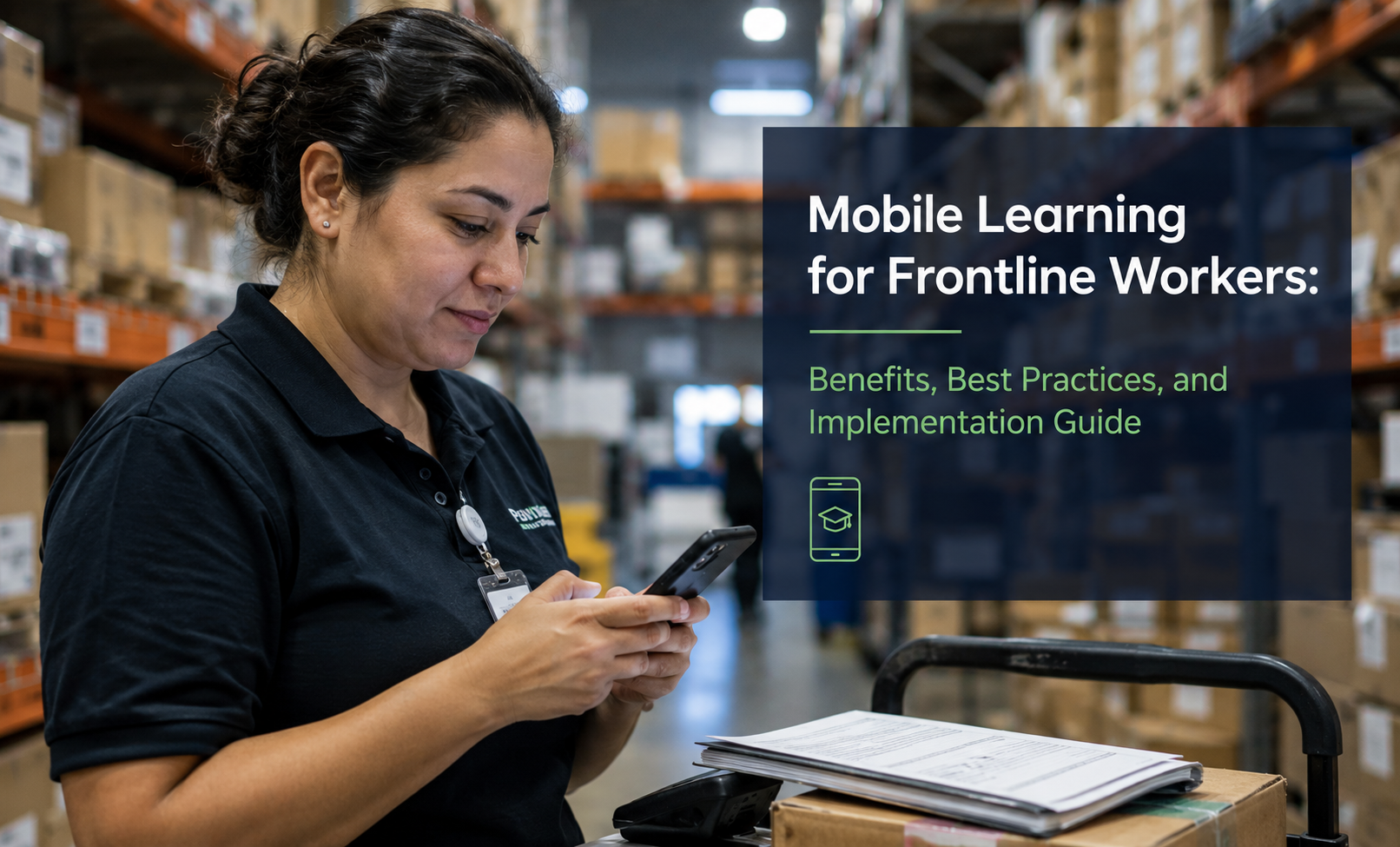
Frontline employees don't work behind desks. They serve customers, care for patients, operate machinery, stock shelves, and manage inventory- often with limited time for formal training and little access to a computer.
As organizations expand across locations, shifts, and languages, delivering consistent training becomes increasingly complex. Traditional classroom sessions and desktop-based learning often struggle to keep pace with the demands of a distributed frontline workforce.
Mobile learning addresses this challenge by giving employees access to training on the devices they already use, making learning more flexible, accessible, and easier to scale.
In this guide, you'll learn why mobile learning has become essential for frontline organizations, its key benefits, common implementation challenges, best practices, and how platforms like CT Nova help deliver learning at scale.
Table of Contents
Why Mobile Learning Matters for Frontline Workers
Traditional training was built for office environments. Frontline work is different.
Employees spend most of their day on the move, leaving little time to attend scheduled training sessions or access desktop computers. As a result, many organizations struggle to deliver timely, consistent learning without disrupting daily operations.
Mobile learning brings training directly to employees through smartphones and tablets, allowing them to access learning when it's needed most-whether they're onboarding, preparing for a new task, or refreshing their knowledge on the job.
For Learning & Development teams, mobile learning also makes it easier to deliver standardized training across multiple locations while maintaining a consistent learning experience for every employee.
Key Takeaway
Mobile learning fits naturally into the way frontline employees work, making training more accessible for learners and easier to deliver across a distributed workforce.
Benefits of Mobile Learning for Frontline Workers
Mobile learning helps organizations deliver training more efficiently while giving employees faster access to the knowledge and resources they need to perform their roles confidently.
1. Greater Flexibility for Employees
Frontline employees rarely have uninterrupted time for lengthy training sessions. Mobile learning allows them to complete training when it fits naturally into their workday, reducing operational disruption while making learning easier to access.
2. Faster Employee Readiness
Providing employees with immediate access to onboarding materials, operating procedures, product knowledge, and role-specific resources helps them become productive more quickly. Instead of waiting for scheduled training, employees can find the information they need when it's most relevant.
3. Higher Engagement Through Bite-Sized Learning
Short, focused learning modules are easier to complete than lengthy courses and fit more naturally into a frontline employee's schedule. Interactive elements such as videos, quizzes, and scenario-based exercises also encourage greater participation and improve knowledge retention.
4. Reliable Learning- Even Without Internet Connectivity
Reliable internet access isn't always available in warehouses, manufacturing facilities, healthcare settings, retail stores, or field operations.
Learning platforms that support offline learning allow employees to download training in advance, continue learning without an internet connection, and automatically sync their progress once they're back online.
CT Nova enables frontline employees to continue learning even in low-connectivity environments, helping organizations deliver a consistent learning experience regardless of location.
5. Easier Training at Scale
As organizations grow, managing training manually across multiple teams, locations, and shifts becomes increasingly difficult.
Mobile learning enables Learning & Development teams to assign training, distribute updates, and maintain consistent learning experiences from a centralized platform, reducing administrative effort while ensuring employees always have access to the latest training.
Traditional Training vs. Mobile Learning
| Traditional Training | Mobile Learning |
|---|---|
| ✕ Classroom-based sessions | ✓ Learning on smartphones and tablets |
| ✕ Fixed training schedules | ✓ Flexible, self-paced learning |
| ✕ Lengthy courses | ✓ Bite-sized learning modules |
| ✕ Internet-dependent access | ✓ Online and offline learning |
| ✕ Manual content updates | ✓ Instant digital updates |
| ✕ Inconsistent experiences across locations | ✓ Standardized learning across teams |
| ✕ Paper-based tracking | ✓ Centralized reporting and analytics |
Key Takeaway
Mobile learning enables organizations to deliver training that is more flexible, scalable, and aligned with the realities of frontline work. By making learning available whenever employees need it—including in low-connectivity environments-organizations can improve employee readiness while simplifying training delivery across distributed teams.
Common Challenges of Mobile Learning
Adopting mobile learning is only the first step. To build a successful learning program, organizations need to create engaging content, make training accessible in different working environments, and measure whether learning is improving employee performance.
Here are four common challenges organizations should be prepared to address.
1. Keeping Employees Engaged
Simply making training available on a mobile device doesn't guarantee employees will complete it. Long, text-heavy courses can feel overwhelming, especially for frontline employees with limited time during their shifts.
Organizations can improve engagement by delivering short, focused lessons supported by videos, quizzes, and scenario-based activities. Content that is practical and immediately relevant to an employee's role is far more likely to be completed and retained.
2. Supporting Employees in Low-Connectivity Environments
Many frontline employees work in environments where internet connectivity is unreliable, including warehouses, manufacturing plants, construction sites, and remote field locations.
Platforms with offline learning capabilities allow employees to download training in advance, continue learning without an internet connection, and automatically sync their progress once they're back online. This ensures training remains accessible regardless of location.
3. Delivering Consistent Training Across Multiple Languages
For global organizations, language can become a major barrier to effective learning. Maintaining separate versions of every course across multiple languages is time-consuming and difficult to manage as training content evolves.
AI-powered translation helps simplify this process by allowing organizations to create learning content once and deliver it in multiple languages. CT Nova supports AI-powered translation into natural, conversational Hindi, with Portuguese and Spanish planned, helping organizations provide a more inclusive learning experience for multilingual frontline teams.
4. Measuring Learning Effectiveness
Completion rates provide only a partial picture of training success. To understand whether learning is improving performance, organizations should also track assessment scores, learner engagement, knowledge retention, compliance progress, and time to proficiency.
These insights help Learning & Development teams identify skill gaps, provide targeted support, and continuously improve training programs.
Key Takeaway
Successful mobile learning depends on more than mobile access. Organizations that prioritize engaging content, offline accessibility, multilingual learning, and meaningful performance insights are better positioned to build training programs that deliver lasting business impact.
Best Practices for Successful Mobile Learning
The most effective mobile learning programs are designed around how frontline employees actually work. These best practices can help organizations improve adoption, simplify administration, and maximize learning outcomes.
1. Design for Mobile First
Create learning experiences specifically for smartphones and tablets instead of adapting desktop-based courses. Clean layouts, intuitive navigation, and mobile-friendly interactions make training easier to access and complete.
2. Keep Learning Short and Focused
Frontline employees often have limited time for formal training. Breaking content into bite-sized modules allows employees to learn in short sessions while improving completion rates and knowledge retention.
3. Personalize Learning by Role
Different teams require different knowledge. Organizing learning into role-based pathways ensures employees receive training that is relevant to their responsibilities, reducing unnecessary content and helping them become productive more quickly.
4. Measure Outcomes Beyond Course Completion
Effective learning should lead to measurable business outcomes. Alongside completion rates, organizations should monitor:
Assessment performance
Knowledge retention
Time to productivity
Compliance readiness
Learner engagement
Manager feedback
These metrics provide a clearer understanding of how training impacts employee performance and where improvements are needed.
Key Takeaway
Successful mobile learning programs are built around the needs of frontline employees. By designing for mobile devices, delivering concise and relevant content, personalizing learning, and measuring meaningful outcomes, organizations can create learning experiences that scale with their workforce.
Mobile Learning Implementation Checklist
Implementing mobile learning successfully requires more than choosing the right platform. Organizations need a clear strategy, relevant content, and a process for continuously improving the learning experience.
Use this checklist as a guide when launching or optimizing your mobile learning program.
| Before Launch | During Rollout | Ongoing Improvement |
|---|---|---|
| Define learning objectives for each role. | Ensure employees can easily access training on their mobile devices. | Review learner engagement and assessment results regularly. |
| Design content specifically for mobile screens. | Test the learning experience across different devices. | Gather feedback from employees and managers. |
| Break long courses into bite-sized learning modules. | Communicate training expectations clearly. | Update learning content to reflect new procedures or policies. |
| Create role-based learning paths. | Monitor completion and knowledge checks. | Identify learning gaps and provide refresher training where needed. |
| Plan for employees working in low-connectivity environments. | Support managers with learner progress and reporting. | Continuously improve learning using analytics and performance data. |
How Technology Supports Mobile Learning
As organizations expand, managing training manually becomes increasingly difficult. Assigning courses, tracking learner progress, updating content, and ensuring employees receive the right training at the right time can quickly create a significant administrative burden.
Modern learning platforms simplify these processes by automating routine tasks and giving Learning & Development teams greater visibility into training performance.
CT Nova helps organizations deliver mobile learning at scale by enabling them to:
Deliver learning through a mobile-first experience across smartphones and tablets.
Allow employees to continue learning even without internet connectivity, with progress syncing automatically once they're back online.
Create personalized learning paths based on an employee's role, department, or location.
Automate learner enrolment and course assignments.
Track learner progress, assessments, and engagement through centralized reporting.
Deliver multilingual learning using AI-powered translation, making training more accessible for global frontline teams.
Keep learning content up to date through centralized content management.
Ready to Modernize Mobile Learning?
Mobile learning is no longer just a convenient way to deliver training-it's becoming an essential part of how frontline organizations develop, support, and retain their workforce. By making learning accessible on the devices employees already use, organizations can create training experiences that fit naturally into the flow of work while maintaining consistency across teams and locations.
Whether you're launching a mobile learning program or replacing a legacy learning platform, CT Nova helps organizations deliver scalable, mobile-first learning experiences with offline access, AI-powered multilingual learning, personalized learning paths, and centralized reporting.
Schedule a personalized demo to see how CT Nova can help you build a more effective mobile learning program.
