
Frontline Employee Onboarding: Best Practices, Process, Challenges, and Checklist
6 min read
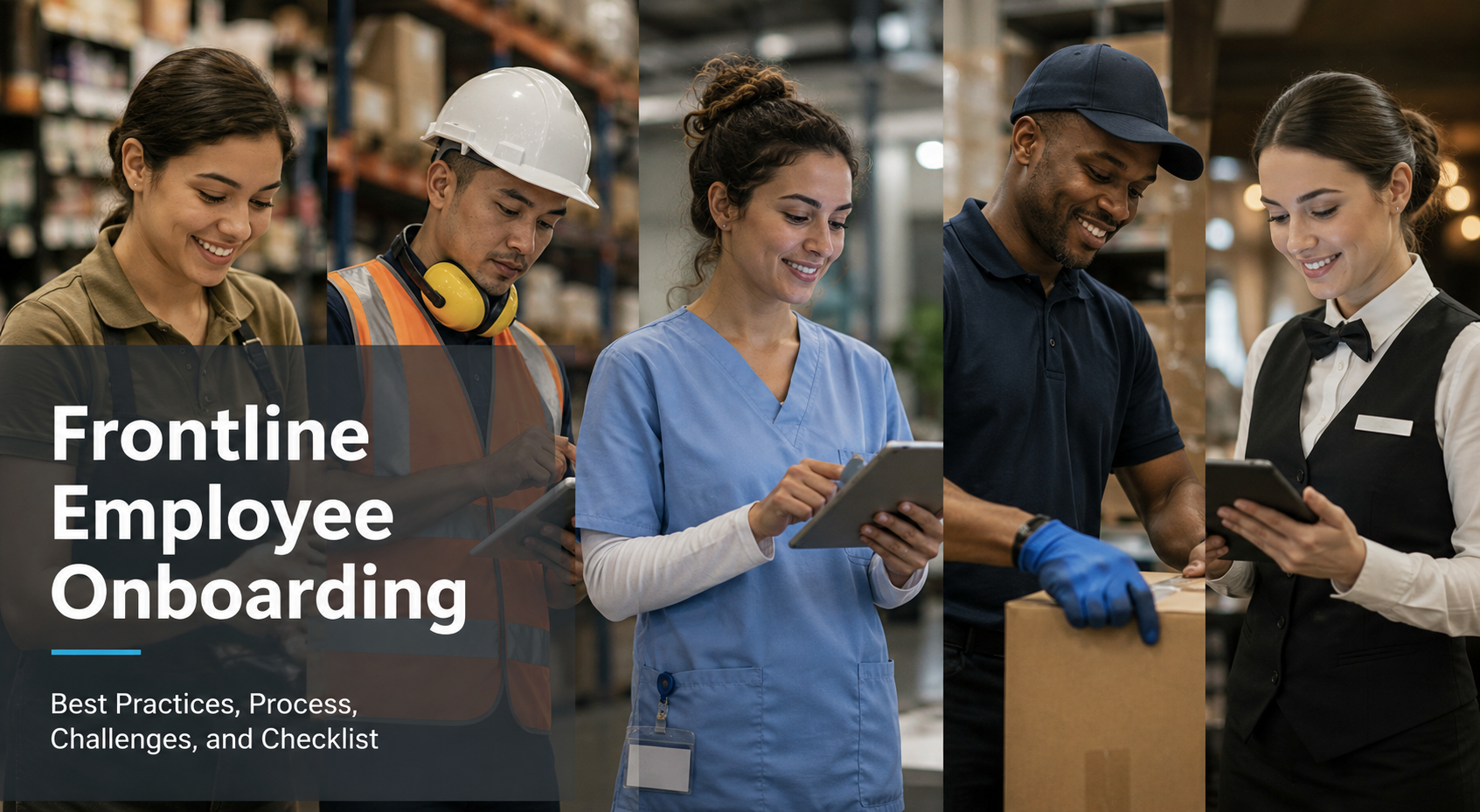
Every new frontline employee starts with the same goal: to do a good job.
For organizations, effective frontline employee onboarding is about helping new hires become productive, confident, and ready to perform safely from day one.
Unlike office-based employees, frontline workers have limited time for training and often need to apply what they've learned immediately. As organizations grow across locations and languages, delivering a consistent onboarding experience becomes increasingly challenging.
Leading organizations are moving beyond one-time orientation sessions by combining mobile-first learning, bite-sized training, and AI-powered multilingual learning to make onboarding easier to scale.
In this guide, you'll learn the biggest frontline employee onboarding challenges, best practices for building onboarding programs that scale, a practical onboarding checklist, and how modern learning platforms like CT Nova simplify onboarding for distributed frontline teams.
Table of Contents
Why Frontline Employee Onboarding Is Different
Every employee benefits from a strong onboarding experience, but onboarding frontline workers comes with unique challenges.
Frontline employees spend their day serving customers, caring for patients, operating equipment, stocking shelves, or supporting essential operations. They don't have hours available for classroom training, and many don't have regular access to a desktop computer. Learning needs to be practical, accessible, and easy to complete during the flow of work.
Organizations also need to deliver a consistent onboarding experience across multiple locations, roles, and shifts while ensuring employees understand operational procedures and compliance requirements.
For global and multilingual workforces, accessibility adds another layer of complexity. Employees learn most effectively in the language they're most comfortable with, making multilingual onboarding an increasingly important part of frontline learning strategies. AI-powered translation is helping organizations deliver more consistent learning experiences without manually recreating every course.
The most effective onboarding programs recognize that onboarding isn't a one-day event-it's the beginning of continuous learning.
Key Takeaway
The best frontline onboarding programs are designed around how frontline employees actually work. They combine mobile-first learning, role-specific training, and multilingual accessibility to help employees become productive faster while maintaining consistency across the organization.
Common Frontline Employee Onboarding Challenges
Every frontline organization wants new hires to become productive quickly. As organizations grow across locations, roles, and languages, delivering a consistent onboarding experience becomes increasingly complex. Here are the five biggest challenges organizations face.
1. High Employee Turnover
Retail, hospitality, logistics, healthcare, and manufacturing often experience higher employee turnover than office-based industries.
Every new hire requires onboarding, role-specific training, compliance education, and manager support. As hiring volumes increase, manually coordinating these activities becomes increasingly difficult.
Without a structured onboarding process, managers often rely on informal coaching, resulting in inconsistent experiences across locations and longer ramp-up times for new employees.
Organizations that standardize onboarding are better positioned to deliver a consistent employee experience while reducing the administrative burden on managers and Learning & Development teams.
Key Takeaway
Scalable onboarding starts with a repeatable process that delivers a consistent experience regardless of location or manager.
2. Limited Time for Learning
Frontline employees don't spend their day behind a desk.
They're serving customers, caring for patients, operating equipment, stocking shelves, or managing inventory. Taking employees away from these responsibilities for hours of classroom training isn't always practical.
That's why traditional onboarding often struggles in frontline environments.
Leading organizations are replacing lengthy onboarding sessions with shorter, mobile-friendly learning experiences that employees can complete before a shift, during scheduled breaks, or whenever it's most convenient. This approach improves engagement while helping employees apply what they've learned sooner.
3. Delivering Consistent Onboarding Across Locations and Languages
As organizations expand across cities, regions, or countries, delivering consistent onboarding becomes increasingly challenging.
Employees performing the same role may work in different locations, report to different managers, or speak different languages. While training content is often created in English, many frontline employees learn most effectively in their preferred language.
Traditionally, translating onboarding content required maintaining separate versions of every course-an approach that is difficult to scale and keep up to date.
AI-powered translation is changing that.
Organizations can now create onboarding content once and translate it into multiple languages more efficiently, making learning more accessible while maintaining consistency across their workforce. Instead of spending time recreating courses, Learning & Development teams can focus on improving learning quality and supporting employees.
CT Nova is expanding its multilingual onboarding capabilities through AI-powered translation. Content created in English can be translated into natural, conversational Hindi using an AI translation engine, with support for additional languages such as Portuguese and Spanish planned. This helps organizations deliver consistent onboarding experiences while reducing the effort required to localize training for distributed frontline teams.
4. Balancing Compliance With Practical Learning
Many frontline roles require employees to complete mandatory compliance and safety training before they begin working independently.
While compliance is essential, onboarding shouldn't become a series of checkboxes.
Employees also need practical knowledge they can immediately apply in their role, from customer interactions to operational procedures and equipment handling.
The most effective onboarding programs balance regulatory requirements with hands-on learning that prepares employees for real-world situations.
5. Limited Visibility Into Employee Progress
Managers often don't know whether a new employee is struggling until performance issues begin to appear.
Without centralized reporting, it's difficult to understand which employees have completed onboarding, where learning gaps exist, or when additional coaching may be needed.
Better visibility enables managers to provide timely support while helping Learning & Development teams continuously improve onboarding programs.
Traditional Frontline Onboarding vs. Modern Frontline Onboarding
| Traditional Frontline Onboarding | Modern Frontline Onboarding |
|---|---|
| ✕ One-day orientation | ✓ Continuous onboarding journey |
| ✕ Lengthy classroom sessions | ✓ Bite-sized, mobile-friendly learning |
| ✕ Paper-based checklists | ✓ Digital onboarding workflows |
| ✕ Generic onboarding for every role | ✓ Role-specific learning paths |
| ✕ Manager-led manual follow-ups | ✓ Automated reminders and progress tracking |
| ✕ Desktop-only access | ✓ Learn anytime, anywhere on mobile devices |
| ✕ Training completion is the goal | ✓ Employee readiness and performance are the goal |
| ✕ Limited visibility into onboarding progress | ✓ Centralized reporting and real-time insights |
Frontline Employee Onboarding Best Practices
Organizations that consistently deliver effective onboarding don't simply provide more training.
They build learning experiences around the realities of frontline work.
Here are four best practices that help organizations onboard frontline employees more effectively.
1. Start Before the First Shift
Great onboarding begins before employees arrive.
Preparing uniforms, system access, schedules, learning resources, and welcome communications before day one helps employees feel prepared and allows them to focus on learning rather than logistics.
A strong pre-boarding experience also creates a positive first impression and reduces the time it takes for employees to become productive.
2. Deliver Mobile-First, Bite-Sized Learning
Frontline employees rarely have uninterrupted time for lengthy training sessions.
Breaking onboarding into shorter learning modules allows employees to complete training at their own pace while fitting learning around their work schedule.
Mobile-first learning also ensures employees can access onboarding content whenever they need it, whether they're in a store, warehouse, healthcare facility, or working in the field. Mobile accessibility and microlearning have become key components of effective frontline learning strategies.
Key Takeaway
The best onboarding programs fit into the workday instead of taking employees away from it.
3. Make Learning Accessible in Every Language
Language should never become a barrier to effective onboarding.
When employees learn in the language they're most comfortable with, they're more likely to understand important procedures, retain critical information, and apply that knowledge confidently on the job.
Rather than maintaining separate versions of every course, organizations can now use AI-powered translation to make onboarding content accessible to multilingual workforces.
CT Nova is investing in AI-powered translation capabilities that allow organizations to create content once and deliver it in multiple languages. Today, onboarding content can be translated into conversational Hindi using an AI translation engine, with support for languages such as Portuguese and Spanish planned in the future. This enables organizations to scale multilingual onboarding while maintaining consistency across every location.
4. Measure Employee Readiness, Not Just Completion
Completing onboarding doesn't necessarily mean an employee is ready to perform independently.
Organizations should look beyond completion rates and measure outcomes such as:
Time to productivity
Knowledge retention
Assessment performance
Compliance readiness
Manager feedback
Early employee retention
These insights help Learning & Development teams continuously improve onboarding while demonstrating its impact on operational performance.
Key Takeaway
The most effective frontline onboarding programs measure employee confidence, readiness, and business outcomes-not simply whether training was completed.
Frontline Employee Onboarding Checklist
Even the best onboarding strategy needs a clear execution plan.
A standardized checklist helps ensure every frontline employee receives a consistent onboarding experience regardless of their role, manager, location, or shift pattern. It also reduces administrative effort and gives managers confidence that every critical step has been completed.
Use the checklist below as a starting point for building a scalable frontline onboarding program.
Before Day One
Prepare uniforms, equipment, and system access.
Share a welcome message and first-day schedule.
Assign mandatory compliance and policy training.
Introduce the employee to their manager and team.
Ensure learning resources are accessible on mobile devices.
First Shift
Welcome the employee and introduce key team members.
Explain role expectations and performance standards.
Complete essential safety and compliance training.
Demonstrate core workflows and operating procedures.
Provide opportunities to observe experienced colleagues.
First Week
Deliver role-specific training in bite-sized learning modules.
Reinforce key concepts through practical application.
Schedule manager check-ins to answer questions and provide feedback.
Monitor onboarding progress and assessment results.
Identify any additional support or coaching required.
First Month
Review progress against onboarding milestones.
Address knowledge gaps through refresher learning.
Introduce advanced role-specific training.
Gather feedback on the onboarding experience.
Set development goals for continued learning.
How Technology Improves Frontline Employee Onboarding
Scaling frontline onboarding is challenging when employees are spread across multiple locations, work different shifts, or speak different languages.
Manual processes-such as assigning courses, tracking completion in spreadsheets, and following up individually with managers-become increasingly difficult as organizations grow.
Modern learning platforms simplify onboarding by automating repetitive tasks while giving Learning & Development teams greater visibility into employee progress. Instead of managing logistics, teams can focus on improving learning outcomes and supporting employees throughout their onboarding journey. Enterprise learning platforms are increasingly emphasizing mobile-first access, multilingual delivery, AI-assisted learning, and centralized analytics to support distributed frontline workforces.
CT Nova helps organizations modernize frontline employee onboarding by enabling them to:
Deliver personalized onboarding journeys based on an employee's role, location, or department.
Automate learner enrolment and onboarding workflows.
Track progress through centralized dashboards and real-time reporting.
Deliver mobile-first learning that employees can access from virtually any device.
Monitor completion, assessments, and learner engagement across teams.
Make Multilingual Onboarding Scalable with AI
One of the biggest challenges for global frontline organizations is delivering consistent training across multilingual workforces.
Training content is often created in English, while employees may be more comfortable learning in Hindi, Portuguese, Spanish, or other regional languages. Traditionally, translating every course required maintaining multiple versions of the same content, making updates slow and difficult to manage.
CT Nova is expanding its AI-powered translation capabilities to solve this challenge.
Organizations will be able to create onboarding content once and use an AI translation engine to generate natural, conversational translations for frontline learners. Initial support includes colloquial Hindi, with additional languages such as Portuguese and Spanish planned as these capabilities expand.
This approach helps Learning & Development teams scale multilingual onboarding more efficiently while ensuring employees receive training in a language they understand-improving accessibility, consistency, and knowledge retention without duplicating content. CT Nova's platform is designed to support training across geographies, languages, and devices, with multilingual learning already forming a core part of its product direction.
Key Takeaway
Technology should remove barriers to learning-not create them. The right platform makes onboarding easier to manage for administrators while making learning more accessible, engaging, and relevant for every frontline employee.
Ready to Modernize Frontline Employee Onboarding?
Effective frontline employee onboarding goes beyond helping new hires complete their first day. It equips them with the knowledge, confidence, and support they need to perform safely, consistently, and productively from the very beginning.
As organizations grow, delivering that experience across multiple locations, teams, and languages becomes increasingly complex. The right learning platform helps simplify onboarding, improve consistency, and reduce the administrative burden on managers and Learning & Development teams.
Whether you're improving frontline employee onboarding or migrating from a legacy learning platform, CT Nova helps you deliver consistent, scalable onboarding experiences through mobile-first learning, AI-powered multilingual training, personalized learning paths, and seamless migration.
Schedule a personalized demo to see how CT Nova can help you build a scalable frontline employee onboarding program.
